

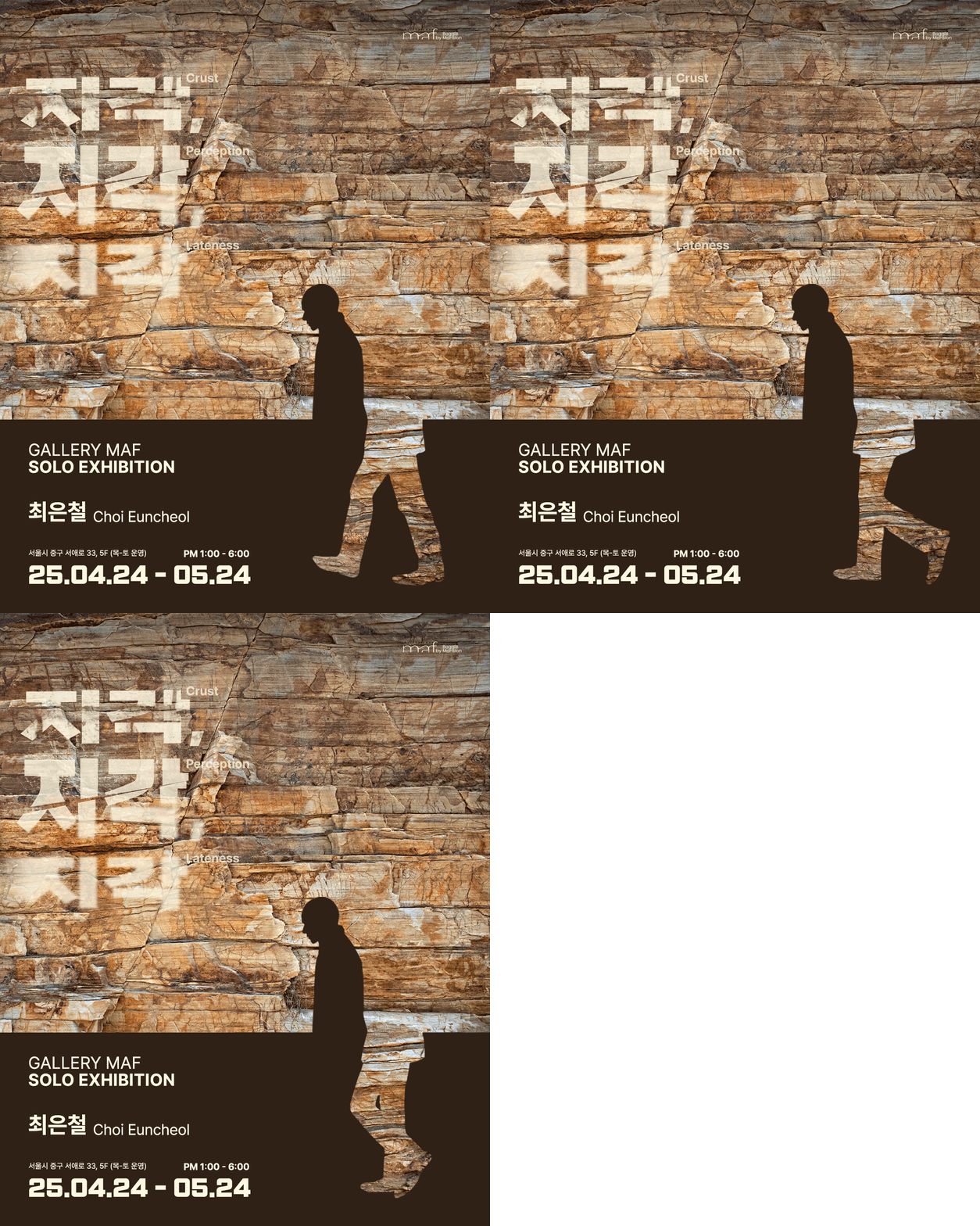
지각(地殼, Crust), 지각(知覺, Perception), 지각(遲刻, Lateness)
24 APR 2025 - 24 MAY 2025 / Gallery MAF, Seoul, South Korea
이번 전시는 <지각(地殼, Crust), 지각(知覺, Perception), 지각(遲刻, Lateness)>이라는 세 개의 층위가 수직적으로 혹은 병렬적으로 연결되며, 서로 유기적인 관계를 형성한다. 한때 단단했던 지층은 부서지고, 퇴적되며, 다시 겹겹이 쌓인다. 그 과정에서 어떤 것은 남고, 어떤 것은 사라진다. 기억 또한 그러하다. 한 시대를 지탱하던 사건과 감각은 시간 속에 퇴적되지만, 일부는 흐려지고, 일부는 예상치 못한 방식으로 다시 드러난다.
“기억은 단순한 과거의 저장이 아니다. 그것은 끊임없이 현재와 뒤섞이며, 새롭게 형성되는 것이다.”
– 앙리 베르그송, 물질과 기억 (1896)
This exhibition weaves together three layers—Crust (地殼), Perception (知覺), and Lateness (遲刻)—connected vertically and in parallel, forming an organic relationship with one another. Once-solid strata fracture, sediment, and are stacked again in layers. In this process, some things remain while others disappear. Memory is no different. Events and sensations that once sustained an era are deposited over time; some grow faint, while others resurface in unexpected ways.
“Memory is not the simple preservation of the past; it is continually intermingled with the present and constantly being newly formed.”
— Henri Bergson, Matter and Memory (1896)
지각(Crust), 쌓이고 깎이는 시간의 흔적
땅이 갈라지고, 다시 포개지는 것처럼, 문명과 기억도 퇴적된다. 우리는 기억을 마치 고정된 형태로 저장된 것으로 여기지만, 그것은 언제나 생성되고 변화하는 과정 속에 있다. 베르그송은 기억이 단순한 ‘기록’이 아니라 지속(durée)의 흐름 속에서 끊임없이 현재와 교차하는 것이라 보았다. 기억은 과거의 흔적을 품은 채 다시 현재로 회귀하고, 그 과정에서 새로운 층을 형성한다. 드로잉 시리즈 <당신이 서 있는 땅 위에>에서는 빙하와 대지의 대립된 형상이 유동적인 선형들과 함께 화면을 구성하며, 대지의 좌표를 형성하고 가시적인 움직임을 드러낸다. 빙하는 거대한 시간의 층이며, 대지는 그 위에 쌓이는 사건과 감각들의 흔적이다.
Crust (地殼), Traces of Time That Accumulate and Erode
Just as the ground fractures and folds back upon itself, civilizations and memories are deposited in layers. We often regard memory as something stored in a fixed form, yet it is always in a state of becoming and transformation. Bergson understood memory not as a simple “record,” but as something that continually intersects with the present within the flow of durée (duration). Memory returns to the present carrying traces of the past, and in that return, it forms new layers.
In the drawing series On the Ground You Are Standing On, opposing forms of glaciers and land compose the pictorial space alongside fluid linear movements, establishing coordinates of the terrain and revealing visible motion. The glacier represents a massive stratum of time, while the land bears the accumulated traces of events and sensations layered upon it.

당신이 서 있는 땅 위에, 2022, 종이 위에 유성 색연필, 나무 구조물 위에 설치, 230 x 120cm


Kirschenberg(Church Hill), 2022-25, 컬러시멘트_80세트 , 가변크기
지각(Perception), 낯설고 익숙한 감각의 틈
우리가 인식하는 세계는 감각을 통해서만 주어진다. 하지만 감각은 불완전하며, 대상과 인식 사이에는 늘 보이지 않는 틈이 있다. 에른스트 마흐는 <인식과 오류> (1905)에서 모든 인식은 감각적 경험에서 출발하며, 우리가 ‘객관적인 실재’라고 믿는 것조차도 감각들의 집합체일 뿐이라고 말한다. 즉, 우리가 바라보는 현실은 이미 우리의 감각과 해석을 거친 가공된 형태이며, 오류와 착각 또한 인식의 일부다. 드로잉 시리즈 <극성의 물질>과 목조 설치작업 <Kirchenberg>은 이러한 감각적 착란을 실험한다. 화면 속에서 극과 극의 형태가 대립하며, 조형물의 위아래 위치가 전환됨으로써 관객은 인지 과정에서 혼란을 경험하게 된다. 우리는 ‘본다’고 믿지만, 실재와 인식 사이의 틈에서 무언가를 놓치고 있을지도 모른다. 전시장에 놓인 유물들은 지각(Crust) 속에서 끌어올려진 파편들이며, 관객은 익숙하면서도 낯선 조합을 통해 기억과 시각을 재구성하게 된다.
Perception, the Gap Between the Familiar and the Strange
The world we perceive is given to us only through the senses. Yet the senses are incomplete, and between an object and its perception there always exists an invisible gap. In Knowledge and Error (1905), Ernst Mach argues that all cognition begins with sensory experience, and that even what we believe to be “objective reality” is nothing more than an aggregate of sensations. In other words, the reality we apprehend is already a processed form, filtered through our senses and interpretations; error and illusion are not exceptions but integral parts of perception itself.
The drawing series Matter of Polarity and the wooden installation Kirchenberg experiment with such sensory disorientation. Within the pictorial field, forms at opposite extremes confront one another, while the inversion of up-and-down positions in the sculptural structures induces confusion in the viewer’s cognitive process. We believe that we “see,” yet we may be missing something within the gap between reality and perception. The artifacts placed in the exhibition space are fragments drawn up from within the crust of perception, and through their familiar yet unfamiliar combinations, viewers are prompted to reconstruct memory and vision anew.


Kirschenberg(Church Hill), 2022
자작나무합판, 목봉, 60×180×180cm

역사적이지 않은 유물 (unhistorical Artifact), ver.2025
설탕도자기, 설탕, 식용색소, 나무 구조물안 갈라진 백토 위에 설치_130×100×30cm 프로메테우스 유리 위에 설치, 이소말트, 식용색소, 2025, 가변크기
흘러내리는 물질 2025, 목봉 위에 설치, 가변크기
극성의 물질, 2016 - 2024, 종이 위에 유성 색연필, 25×25cm, 7set


Perception sculpture I, 2025, 젯소 판넬 위에 색연필, 60×72.5cm

Perception sculpture II, 2025, 젯소 판넬 위에 색연필, 53×65cm, 2 pieces

Missing nose I, II, III, 2022, 리소그래피, 29×42cm, 3set, 협업 Lukas Thein

Ancient Greek sculpture, 2022
리소그래피, 29×42cm, 3set, 협업 Lukas Thein
지각(Lateness), 너무 늦거나 끝내 도착하지 않는 것들
기억은 언제나 시간의 흐름 속에서 불완전하게 도착한다. 어떤 기억은 너무 늦게 떠오르고, 어떤 기억은 예정된 순간이 지나야만 선명해진다. 베르그송은 ‘순간’이 아니라 지속 속에서 사유해야 한다고 말한다. 우리의 경험은 단절된 점들의 연속이 아니라, 끊임없이 흘러가는 시간 속에서 이루어진다. 하지만 그 흐름 속에서 일부 기억들은 끝내 도착하지 않고, 오직 기다림만을 남긴다. 설탕이라는 가변적인 물질로 제작된 오브제들은 환경에 따라 녹아 사라지거나, 예기치 않은 순간에 다른 형태를 드러낸다. 물질에서 비물질로 향하는 이 과정은 기억의 작동 방식과도 닮아 있다. 변화하는 환경 속에서 우리는 무엇을 기억하고, 무엇을 잊어버리는가? 이곳에 놓인 작품들은 단단한 것과 부서지는 것, 남겨진 것과 사라지는 것의 경계에 서 있다. 발굴 현장이자 흐려진 지도이며, 때로는 지워지는 기록이기도 하다. 같은 음의 파생어인 지각(地殼, Crust)은 지층을 이루며 남겨진 흔적이고, 지각(知覺, Perception)은 그 흔적을 해석하는 감각이며, 지각(遲刻, Lateness)은 시간의 틈 속에서 어긋나고 지연되는 움직임이다. 이 세 가지 지각은 끊임없이 중첩되며 서로를 변형시킨다. 지층은 단단해 보이지만 끝없이 균열을 만들고, 감각은 그 속에서 발견한 오브젝트들이 분명한 듯하면서도 오류를 동반하며, 시간은 과거와 현재를 얽어 매면서도 지연된다. 결국 우리가 발굴하는 것은 단순한 유물이 아니라, 기억과 망각, 실재와 착각이 교차하는 흔적이다.
Perception (Lateness), Things That Arrive Too Late or Never Arrive at All
Memory always arrives incompletely within the flow of time. Some memories surface too late, while others become vivid only after their appointed moment has already passed. Henri Bergson argues that thought should not be grounded in isolated “instants,” but in duration. Our experience is not a sequence of discrete points, but something that unfolds within a continuous flow of time. Yet within this flow, certain memories never fully arrive, leaving behind only waiting.
Objects made of sugar—a mutable material—melt and disappear depending on their environment, or reveal unexpected forms at unforeseen moments. This process of transformation from material to immaterial closely resembles the workings of memory itself. Within ever-changing conditions, what do we remember, and what do we forget?
The works placed here stand at the boundary between what is solid and what collapses, what remains and what vanishes. They are at once an excavation site and a blurred map, sometimes even an erasing record. The homophonic term jigak unfolds into three meanings: Crust (地殼), the layered traces left behind as strata; Perception (知覺), the sensory faculty that interprets those traces; and Lateness (遲刻), a movement that slips, delays, and falls out of sync within the gaps of time. These three modes of perception continuously overlap and transform one another. The strata may appear solid, yet they endlessly fracture; perception encounters objects within them that seem clear but are accompanied by error; and time entangles past and present while remaining perpetually deferred. Ultimately, what we excavate is not simply an artifact, but a trace where memory and forgetting, reality and illusion, intersect.


역사적이지 않은 유물(ver.2025), 2025
설탕도자기, 설탕, 식용색소, 나무 구조물안 갈라진 백토 위에 설치
프로메테우스, 2025, 유리 위에 설치, 이소말트, 식용색소, 130 x 100 x 30cm / 가변크기


역사적이지 않은 유물(ver. 2025), 2025, 설탕도자기, 설탕, 식용색소, 나무 구조물 안에 설치, 130 x 100 x 30cm

Self-Perception, 2025, 설탕캐스팅, 이소말트, 식용색소, 가변크기
흘러내리는 물질 2025, 목봉 위에 설치, 가변크기


